Sunday, February 26, 2023
The Egg Sandwich Problem, Part II: The Proof
Saturday, January 14, 2023
The Egg Sandwich Problem, I
Sometimes, a problem is so interesting that I can’t help but drop everything to think about it. That was what happened at breakfast a few days ago, when my family and I were trying to making egg sandwiches, consisting of a fried over easy egg, a piece of cheese, and a Panera bagel. There’s four of us, and due to a kind Panera employee, there was an extra bagel. (Yes, I in particular made the judgement call that a Panera bagel was worth it, but it was better to make the sandwich part at home rather than paying the premium.)
So, we made the extra sandwich, and went to divide it equally. It’s pretty easy to split a round sandwich – just cut it in half along a diameter, and then in half again with the perpendicular diameter.
But there was a problem: the yolk on the fried egg was off-center, like yolks always are. Splitting the sandwich in the usual way would result in an unfair split of the yolk.
And it was at this point that I abandoned the idea of eating
breakfast and went to find some paper.
So, here’s the problem. Given an egg sandwich, with the yolk
off-center, is it possible to divide the sandwich into four equal pieces so
that everyone gets the same amount of sandwich and the same amount of yolk?
Let’s start with some assumptions.
Bagels are round, so we can approximate the sandwich itself as a perfect circle. The bagel we were working with didn’t have a hole in the center (thank Panera’s Asiago bagel design for that simplification), so we don’t have to worry about that, either.
Fried eggs aren’t usually round, but the pan we used to fry them in is tiny and made specifically for frying a single egg at a time, so we can approximate the egg as a perfect circle.
The fried egg is about the same size as the bagel, so we can assume that they are perfectly aligned and the same shape and size.
The yolk of an egg is more or less a perfect sphere, and in a fried over easy egg, we can disregard the dome shape of the cooked yolk and approximate it as a circle. Notably, this circle is smaller than the circle of cooked egg white, and it’s also fully contained within the circle.
There’s a subtler assumption here about the size of the yolk compared to the egg, but I don’t know how to formalize it yet.
The yolk of a fried egg is not necessarily in the center of the egg. If it were, this problem would be trivial.
The cheese we used was a square of sharp cheddar, and I’m going to disregard it completely – we’re only optimizing for equal amounts of egg, bagel, and yolk.
Now, we move to intuition. My intuition says that to divide this into four pieces, the case with which I found this presented, it’ll be easier to divide the sandwich into two equal pieces and subdivide the equal pieces. We can exploit the symmetry of the diagram for this – if a circle is contained inside another circle, and they’re not necessarily concentric, you can draw a line between their centers to find an axis of symmetry for the combined shape. In this way, if we’re cutting this up for four people, we get a “free” first cut – no matter where the yolk is, we’re guaranteed to be able to make this cut.
And now that we have two identical pieces, and one cut
already made, you can see that the third cut is also made for us. If we find a
way to divide one of the pieces equally, we can just repeat that cut on the
other piece, and we’ll have four equal pieces!
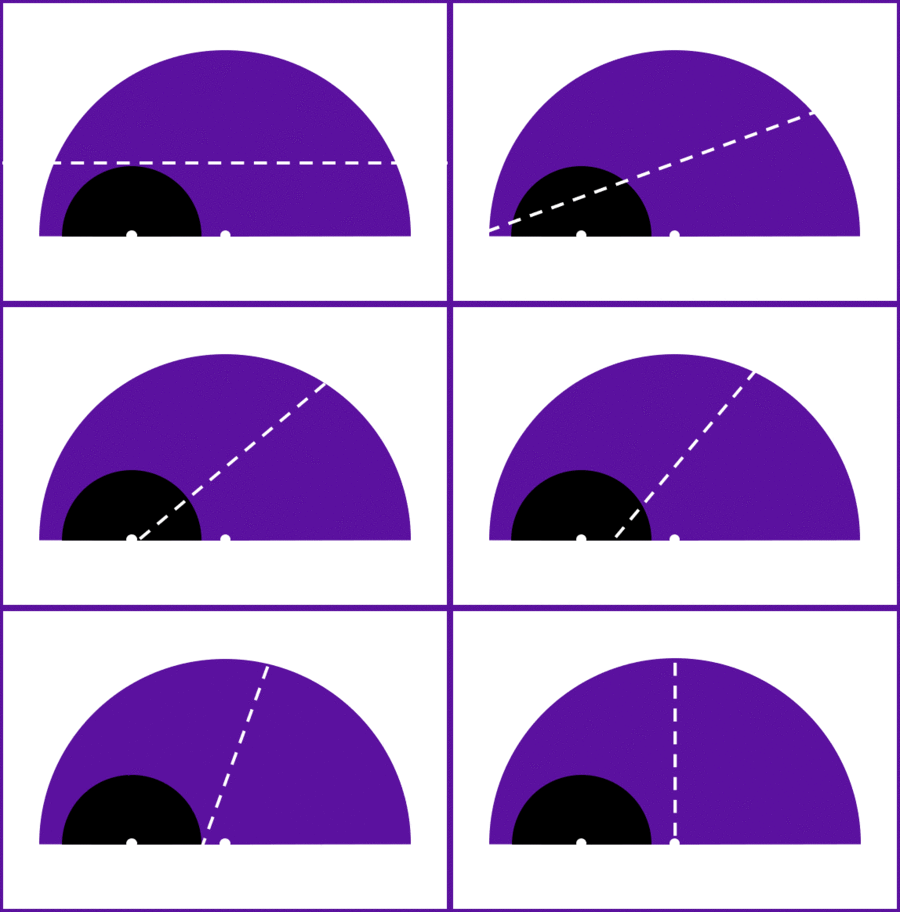
Now, the second cut is the hard part. How can we make a cut
that divides both the sandwich and yolk equally? Is such a cut possible for any
possible position that the yolk can be in? We’ll have to delve into that next
time, because there’s a fancy animation I’m trying to make that is taking
forever. Hopefully it ends up working and you can see it next time!
Tuesday, July 26, 2022
Birthday Puzzle 2022!
It's time for another birthday puzzle! This year, my birthday puzzle was CLASSIFIED. I've never done anything like that before, so it had a lot of puzzle ideas that had been building up in me for a while!
But, I couldn't resist also making something smaller in scope but wider in audience for a birthday puzzle. It's definitely simpler than many of its predecessors, but I enjoyed creating it all the same. I hope you enjoy solving it!
Sunday, May 1, 2022
Sequence Differences (Diffsy Qs I)
Years and years ago, back in my old Math League days, I came up with a trick to finding out the formulas of sequences. The problem type I'm talking about would give me a list of Xs and Ys in a table like this:
Wait, I need HTML for tables? Wow, okay.
| X | 1 | 2 | 3 | 4 | 5 |
|---|---|---|---|---|---|
| Y | 4 | 8 | 14 | 22 | 32 |
Oh my god, I thought I hated tables when I only knew of how awful they were in the context of word processors. HTML tables are so much worse.
Anyways, the problems would have a table like the one above and ask for the equation that generated those values, usually in the form of y = f(x). There aren't any convenient algorithms for this, so usually the student is expected to graph it, determine if it's a line or parabola, and use the appropriate equations.
This problem is actually one of the few interesting math problems that a student might see in school. I categorize a lot of math taught in schools as a three step process:
1. Remember the formula or algorithm that applies to this problem.
2. Apply the formula or algorithm and follow the steps.
3. Write down the result.
This problem gets an additional step; an analysis of the results, as simple as it may be.
1. Remember the formula or algorithm that applies to this problem (Hm, when the problem looks like this, I have to graph the points on a Cartesian plane)
2. Apply the formula or algorithm and follow the steps. (Actually graph each point)
3. Analyze the results. (Check if the graphed points follow a line or a parabola)
4. Remember the formula or algorithm that applies to this problem (Remember the appropriate formulas for your graph)
5. Apply the formula or algorithm and follow the steps. (Use the appropriate formulas / plug 'n chug)
6. Write down the result (The formulas spit out this number for the slope and this number for the y-intercept, so I can put them in place of the m and the b and write down the equation)
Yeah, that additional analysis step is very simple, but it's one of two examples that come to mind in the math I learned as a kid that weren't completely algorithmic. (The other is triangle congruence, which was always a favorite of mine!)
This analysis step is something I loved back then, because I could get around it with some thinking. Why bother graphing out all those points when you can just intuitively figure out whether the points will make a line or a parabola? (Well, because the teacher's going to take points away for not showing your work, that's why.)
So, how do you figure out whether it's a line or a parabola without graphing it? I came up with a method that I'm now going to retroactively call "Sequence Differences". I called them "subsequences" back then, but it turns out that that term is protected. I subtracted adjacent y values from each other to make a new sequence that had one fewer term. Let's see if I can get a table to illustrate that:
| X | 1 | 2 | 3 | 4 | 5 |
|---|---|---|---|---|---|
| Y1 | 4 | 8 | 14 | 22 | 32 |
| Y2 | 4 | 6 | 8 | 10 |
Eh, close enough. As you can see, the Y2 sequence comes from 8 - 4, 14 - 8, 22 - 14, and 32 - 22. Upon seeing this, I thought "these numbers are all different, and lines have a constant slope, so it must be a parabola!" and went on to the next part of the problem. But isn't it interesting that the numbers are increasing in an arithmetic sequence? If I were to do another round of sequence differences here,
| X | 1 | 2 | 3 | 4 | 5 |
|---|---|---|---|---|---|
| Y1 | 4 | 8 | 14 | 22 | 32 |
| Y2 | 4 | 6 | 8 | 10 | |
| Y3 | 2 | 2 | 2 |
we can see that the sequence is constant. Somehow, every time I performed a sequence difference, I decremented the degree of the source equation. The first equation was y = x2 + x +2; the second can be solved to be y = 2x + 2, and the last is just y = 2. Looks... a bit familiar, doesn't it? The constant isn't the same, but it looks almost like we're taking the derivative to find the equations that describe our new sequences. There's a mystery there!
But, that's probably plenty for one day; it's definitely enough HTML tables for one day. All that remains is a name, and I think I've got a good one. Differential Equations are often abbreviated to Diff Eq, pronounced "Diffy Q", and this problem is about Differences (of) Sequences, so let's go with the almost cringeworthy Diffsy Q. Next time, a deep dive into the mechanics of Diffsy Qs!