Showing posts with label Egg Sandwich. Show all posts

Thursday, February 29, 2024

Gathering 4 Gardner 2024!


It was my second in-person Gathering! After fighting for approximately six years trying to get into the conference, I wasn't going to miss any of them, and it was an amazing one, with a lot of talks about the newly-discovered Spectre and Hat tiles - including from Chaim Goodman-Strauss and -the- Roger Penrose. I can't remember the last time I was starstruck. And then RFP showed the audience his amateur drawing of a pigeon - he had made some tessellation art using the Spectre - and it was the best thing I've ever seen.

I gave a talk on the Egg Sandwich problem. It honestly didn't feel quite as "revolutionary" as Hexprimes, and I was a bit worried that it would be boring or too trivial for the mathematicians and pros out there. After all, it's more or less a simple geometry problem, and without any far-reaching implications, unlike Hexprimes. But, it seemed to be very well-received, and I was humbled by many folks who are definitely masters of their fields coming to me and telling me they enjoyed my silly little story about an extra sandwich.

I also wrote up a paper about Puclow, the Last Substitution Cipher - I may elaborate on that in a post eventually!

Sunday, February 26, 2023

The Egg Sandwich Problem, Part II: The Proof

So, we've got an egg sandwich that we're trying to split up into four equal pieces, and the pesky yolk is off-center. We've already figured out how to make the first cut, right along the line that connects the centers of the circles, and the third cut, which is just going to be the same as the second cut - assuming we can find one. The sandwich is definitely cold by now, but let's forge ahead and figure out the second cut. 

My intuition says that there's a way to make one straight diagonal cut through the semicircle of sandwich that will divide both the sandwich and the yolk in two. My reasoning is a bit involved, but let's walk through it in three steps.

Step 1: Forget the yolk, and imagine some ways we could cut the half sandwich in half. We could cut it straight down the middle, and make two quarter-circles. We could cut it lengthwise - that's a bit trickier, because it's hard to tell where exactly to cut it without doing some measuring, but it is possible to get two equal pieces that way. Or, we could cut it at any random angle.


Side Note: It's not super obvious, but it is actually possible to cut any two-dimensional shape in half... at any given angle. I best visualize this when thinking of waving a knife over a piece of cake. Close your eyes and keep your hand steady and maintain the same angle as you pass over the cake. When you've just started, there's more cake on one side of the knife than the other. When you're almost done, it's reversed - the other side has more cake on it. So, at some point during that wave, the amount of cake on both sides of the knife were equal. It's not always easy to find where to stop and cut, but this thought experiment proves that there always is a place to stop.

This key mathematical concept definitely has a name, but I'm going to call it "The Fair Halves Principle". I reserve the right to change that name to something more catchy / appropriate if I think of something better. Okay, so ignoring the yolk, we can divide the sandwich in half in many ways with many angles of cutting!

Now, Step 2: Add the yolk back in, and apply the Fair Halves Principle on the turning knife.

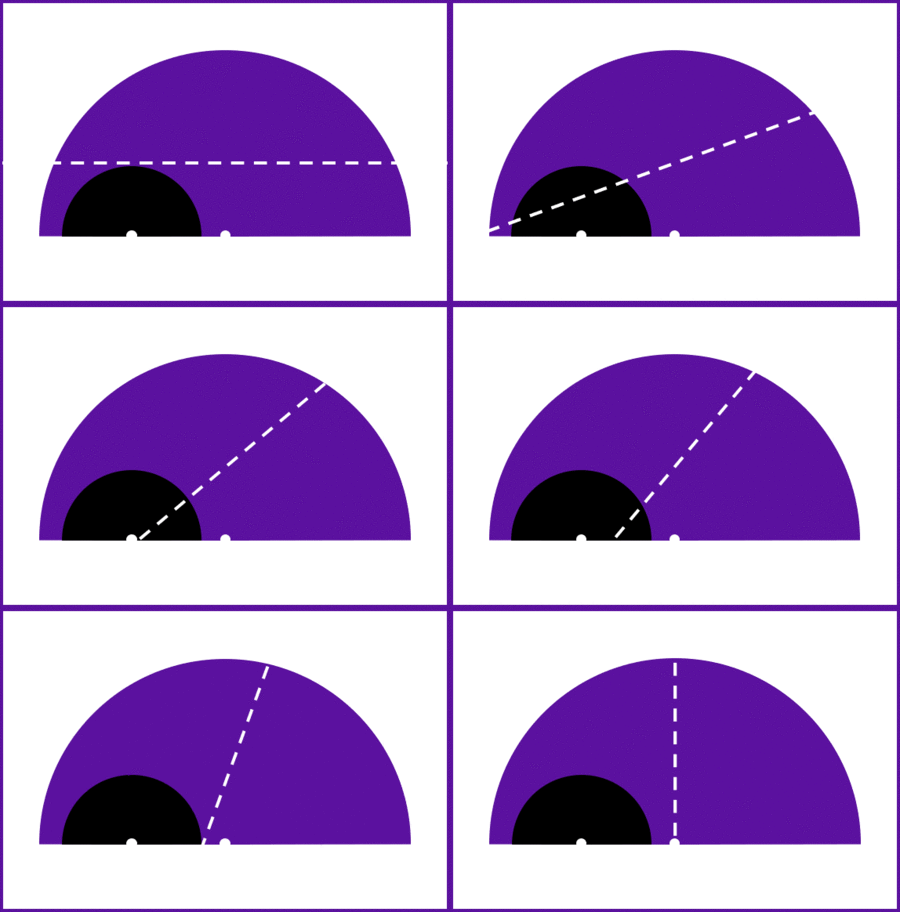
Here's an animation illustrating this. Each of these cuts divides the sandwich in half, and the angle's changing smoothly. (They all hit the centroid of the semicircle, but that's a story for another time.) 


Looking closely, you can see that at the beginning of the animation, there's more yolk on the right/bottom side of the line. At the end, there's more yolk on the left/top side. Because it's a continuous change, we know that at some point, the side that has the most yolk changes from right to left... and exactly at that point, the yolk on both sides must be equal. So, we've proven that there is some cut we can make that will divide both the sandwich and the yolk equally.

But wait a minute, you might be saying. That rotating line only applies when we throw out the yolk! Step 1 relies on the simplicity of the semicircle without having to worry about the yolk. And that's true, so the rotating line above isn't valid for the sandwich + yolk. But here's where Step 3 comes in!

Step 3: at that point we determined in Step 2, where there must exist a line where the yolk is evenly divided, we know two things about that split. One, the yolk on both sides is the same - this is the result of the Fair Halves Principle and Step 2. Two, the halves of the semicircle on both sides is the same - this is the result of the Fair Halves Principle and Step 1. Put them together, and we see that the purple areas (with sandwich and no egg yolk) also must be the same! If the "total sandwich area" and the "yolk area" is the same on both sides of the line, then "the total sandwich area minus the yolk area" must also be the same!

Therefore, we've proven that there exists a line that will work - a cut that will equally divide the yolk and the sandwich. The interesting theoretical work is done; now, we have to actually do the calculations and find the answer so we can eat breakfast!

Saturday, January 14, 2023

The Egg Sandwich Problem, I

Sometimes, a problem is so interesting that I can’t help but drop everything to think about it. That was what happened at breakfast a few days ago, when my family and I were trying to making egg sandwiches, consisting of a fried over easy egg, a piece of cheese, and a Panera bagel. There’s four of us, and due to a kind Panera employee, there was an extra bagel. (Yes, I in particular made the judgement call that a Panera bagel was worth it, but it was better to make the sandwich part at home rather than paying the premium.)

So, we made the extra sandwich, and went to divide it equally. It’s pretty easy to split a round sandwich – just cut it in half along a diameter, and then in half again with the perpendicular diameter.

But there was a problem: the yolk on the fried egg was off-center, like yolks always are. Splitting the sandwich in the usual way would result in an unfair split of the yolk.

And it was at this point that I abandoned the idea of eating breakfast and went to find some paper.

So, here’s the problem. Given an egg sandwich, with the yolk off-center, is it possible to divide the sandwich into four equal pieces so that everyone gets the same amount of sandwich and the same amount of yolk?

Let’s start with some assumptions.

Bagels are round, so we can approximate the sandwich itself as a perfect circle. The bagel we were working with didn’t have a hole in the center (thank Panera’s Asiago bagel design for that simplification), so we don’t have to worry about that, either. 

Fried eggs aren’t usually round, but the pan we used to fry them in is tiny and made specifically for frying a single egg at a time, so we can approximate the egg as a perfect circle. 

The fried egg is about the same size as the bagel, so we can assume that they are perfectly aligned and the same shape and size. 

The yolk of an egg is more or less a perfect sphere, and in a fried over easy egg, we can disregard the dome shape of the cooked yolk and approximate it as a circle. Notably, this circle is smaller than the circle of cooked egg white, and it’s also fully contained within the circle. 

There’s a subtler assumption here about the size of the yolk compared to the egg, but I don’t know how to formalize it yet. 

The yolk of a fried egg is not necessarily in the center of the egg. If it were, this problem would be trivial. 

The cheese we used was a square of sharp cheddar, and I’m going to disregard it completely – we’re only optimizing for equal amounts of egg, bagel, and yolk.


Now, we move to intuition. My intuition says that to divide this into four pieces, the case with which I found this presented, it’ll be easier to divide the sandwich into two equal pieces and subdivide the equal pieces. We can exploit the symmetry of the diagram for this – if a circle is contained inside another circle, and they’re not necessarily concentric, you can draw a line between their centers to find an axis of symmetry for the combined shape. In this way, if we’re cutting this up for four people, we get a “free” first cut – no matter where the yolk is, we’re guaranteed to be able to make this cut.

And now that we have two identical pieces, and one cut already made, you can see that the third cut is also made for us. If we find a way to divide one of the pieces equally, we can just repeat that cut on the other piece, and we’ll have four equal pieces!

Now, the second cut is the hard part. How can we make a cut that divides both the sandwich and yolk equally? Is such a cut possible for any possible position that the yolk can be in? We’ll have to delve into that next time, because there’s a fancy animation I’m trying to make that is taking forever. Hopefully it ends up working and you can see it next time!